NIST CSF 2.0 requirements and evidence
NIST CSF 2.0 describes the security outcomes to aim for, in six Functions. This guide shows each Function and how Strac Comply evidences its outcomes.
- Controls tracked
- 106
- Automated tests cover
- 27 of 106 controls, from 58 integrations
- Evidence types
- Automated tests, policies, documents, security training, risk register, vendors
Last checked November 24, 2026Read as Markdown
What does NIST CSF 2.0 ask for?
The NIST Cybersecurity Framework 2.0 (CSWP 29) groups outcomes into six Functions: Govern, Identify, Protect, Detect, Respond and Recover.
Each Function has Categories and Subcategories. Strac Comply tracks each of the 106 Subcategories as a control.
| Requirement | Controls | Strac Comply features (controls) | Evidence comes from |
|---|---|---|---|
| GV Govern | 31 | Automated tests (1), Policies (31), Documents (18), Policy acceptance (1), Risk register (4), Vendors (3) | Certn, Checkr and Google Workspace |
| ID Identify | 21 | Automated tests (5), Policies (21), Documents (19), Risk register (3), Endpoint Agent | DigitalOcean, GitHub, AWS and 7 more |
| PR Protect | 22 | Automated tests (14), Policies (22), Documents (17), Security training (2), Endpoint Agent | AWS, Google Cloud Platform, Microsoft Azure and 51 more |
| DE Detect | 11 | Automated tests (5), Policies (11), Documents (6) | AWS, CrowdStrike, Google Workspace and 6 more |
| RS Respond | 13 | Automated tests (2), Policies (13), Documents (6) | SentinelOne, CrowdStrike and Microsoft Defender XDR |
| RC Recover | 8 | Policies (8), Documents (5) | Your policies, documents and records |
| Total | 106 |
The number beside a feature is how many controls it evidences. One control often has several kinds of evidence. The counts come from the same mapping your Controls page uses.
Here is what your auditor sees for each kind of evidence:
- Automated tests: daily results of the tests your integrations run, with each failing resource named.
- Policies: approved policies with their version and review dates.
- Documents: required documents, plans and records, each with its approved version.
- Policy acceptance: the record of each employee who accepted a policy, and when.
- Security training: who completed security training, and when.
- Risk register: the approved risk register and its dated snapshots.
- Vendors: vendor risk assessments and security reviews.
How do I track NIST CSF 2.0 from my AI agent?
Ask your agent about NIST CSF 2.0 in plain words. It reads the same readiness, controls and evidence you see in the dashboard.
| MCP tool | Access | What you use it for |
|---|---|---|
| get_compliance_status | Read | Your readiness for NIST CSF 2.0, with the count of audit-ready controls. |
| list_controls | Read | Every control in NIST CSF 2.0, with its completion and gaps. Its framework id is nist-csf-2.0. |
| get_control | Read | One control with the evidence behind it and what is still missing. |
| get_next_actions | Read | Your next tasks for NIST CSF 2.0, in order. |
Try these prompts
- What's our NIST CSF 2.0 readiness?
- Which Protect controls are not audit-ready yet?
- Show me GV.OC-01 and its evidence.
- What should I do next for NIST CSF, in order?
What your agent gets back. Live answers from your workspace: your readiness, each control with its completion and gaps, the evidence behind a control, and your next tasks in order.
Connect your agent first.
How do I get audit-ready for NIST CSF 2.0?
Follow these steps in order. Each one moves controls toward audit-ready on your Frameworks page.
Admin
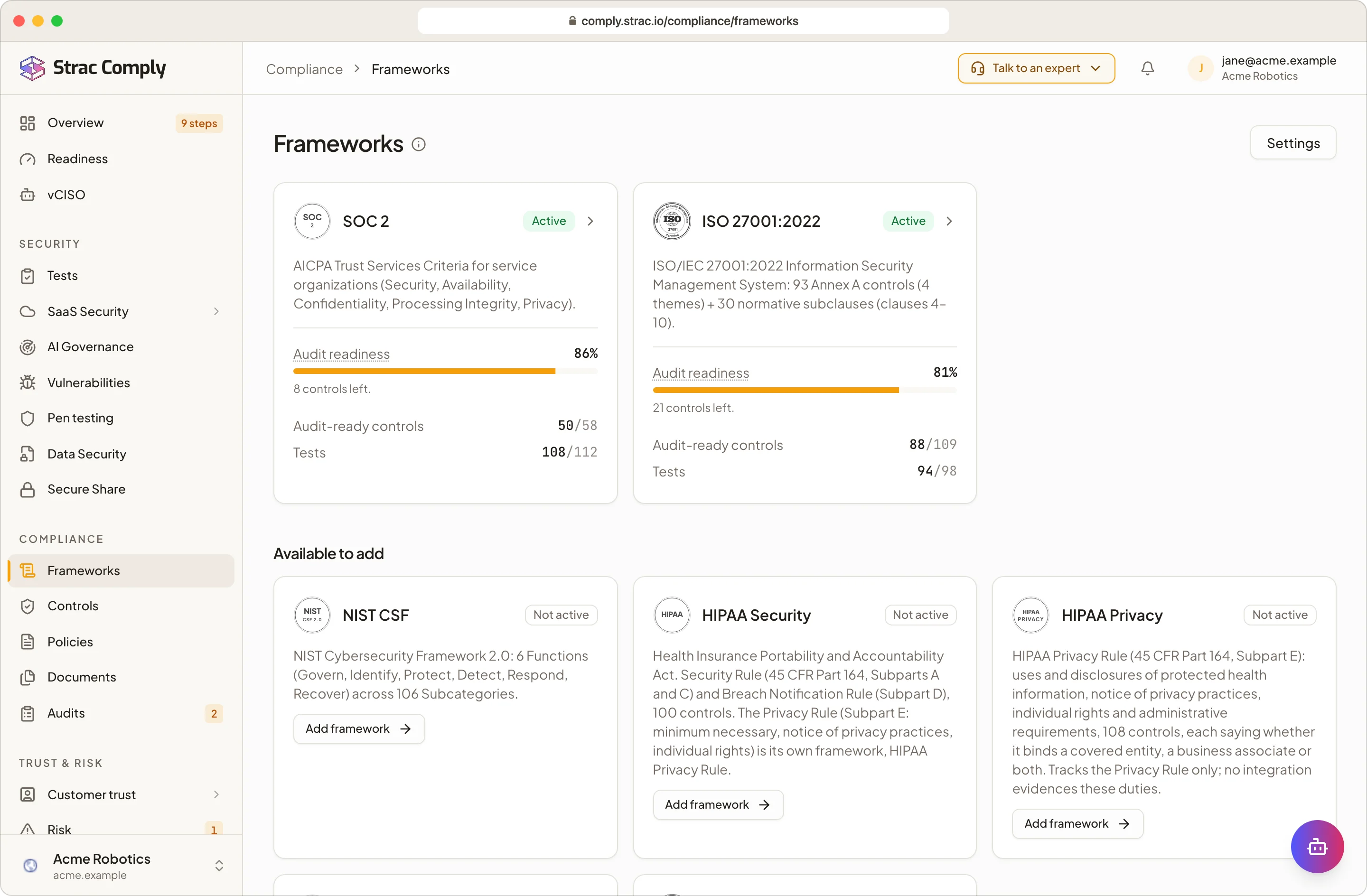
Step 1: Add NIST CSF 2.0
Pick NIST CSF 2.0 in the setup wizard, or add it on the Frameworks page. Every control and the evidence it needs load at once.
Admin
Step 2: Mark what does not apply
Mark the controls that do not apply as not applicable, with a reason.
Admin
Step 3: Connect your systems
Connect your cloud, identity provider and code host on Integrations. Automated tests then run every day and attach results to your controls.
Admin
Step 4: Approve your policies
AI drafts each policy NIST CSF 2.0 needs from your answers. Review and approve each one, then employees accept them by link.
Admin
Step 5: Complete your documents
Open Documents and finish each required document. Strac Comply drafts many of them for you to review.
Admin
Step 6: Approve your risk register
Govern and Identify ask for risk management. Review the risks on Risk and approve the register.
Admin
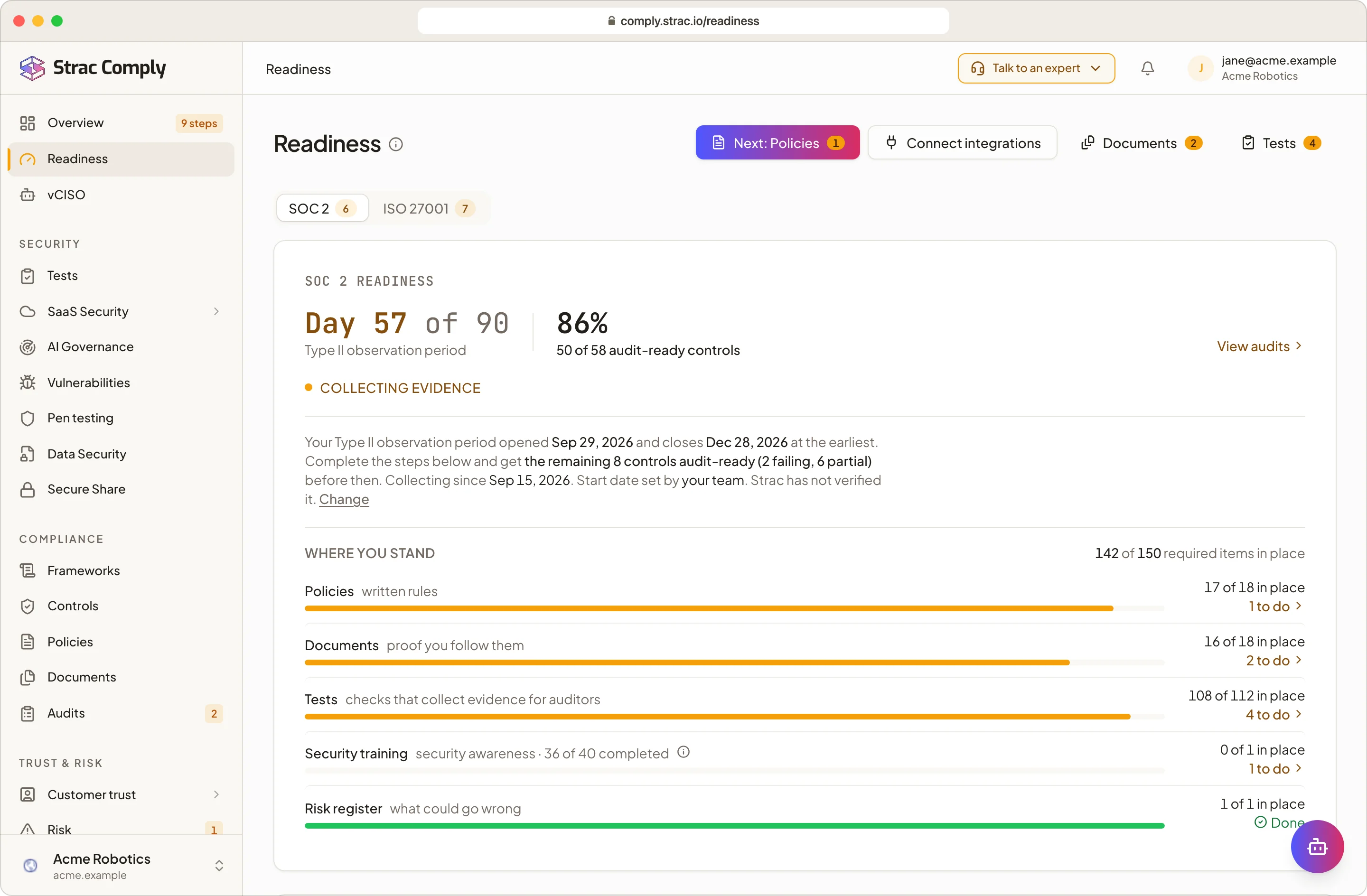
Step 7: Close the gaps
Open Readiness. It lists what is left, in order, until each control is audit-ready.
Admin
Step 8: Share your progress
Group your controls by Function on Controls to show your progress. Invite an outside assessor to the audit portal for a review.
Frequently asked questions
Can we get certified against NIST CSF?
No. NIST CSF is a voluntary framework with no certification. You use it to set a target profile, measure your gaps and show progress.
What changed in CSF 2.0?
CSF 2.0 adds the Govern Function for strategy, roles and supply chain risk. It applies to every organization, not only critical infrastructure.
Does NIST CSF overlap with SOC 2 and ISO 27001?
Yes, a lot. Where the controls match, the same test or policy counts in each framework you add.
What are implementation tiers?
Tiers 1 to 4 describe how rigorous your risk practices are, from Partial to Adaptive. You choose the tier that fits your risk.
Next steps
- NIST CSF 2.0 with Strac ComplyWhat Strac Comply includes for NIST CSF 2.0, and how to start.
- ISO 27001Clauses 4 to 10, Annex A and how Strac Comply evidences them.
- Strac Endpoint AgentCheck every work computer and use the results as evidence.
- Connect your AI agentAdd the MCP server to your agent and see every tool.
New to Strac Comply? Start free trial.